The Great Inversion

A series on American electricity institutions
August 2026

The grid no longer suffers from scarce electricity. It suffers from scarce permission.

Americans are paying more for electricity even after the cost of producing new electricity has fallen dramatically.

That is an institutional failure.

Households pay higher bills and factories wait years for power, while more generating capacity waits in line than currently operates. The bottleneck has moved from the power plant to the grid, where physical constraints are made expensive and slow to manage by rules every reform left standing.

Those rules can be changed, and states can start without Congress.

+33%Residential electricity prices since 2019
> the grid2,061 GW waiting to connect, against ~1,400 GW of operating capacity
5+ yearsTypical wait for an answer, more than eight years in some areas
$31BRate-increase requests tracked in 2025, 2x 2024

The argument

The argument, in six steps

  1. 1

    The seeds of the affordability crisis were planted long ago

    Before data centers were even a thing, regulators set up utilities with monopolies and financial objectives that remain to this day.

  2. 2

    Prior reforms changed process, not roles and incentives

    PURPA in 1978, Order 888 in 1996, Order 1000, Order 2222, Order 2023: each changed the process. None changed what the utility earns, or who controls grid access.

  3. 3

    Capacity is rationed by scarce permission

    Access is administered by a party paid to build the alternative. In what world do those incentives make sense? In decades past when there was no alternative. The technology has changed.

  4. 4

    The old remedy is on the table again

    Build more, keep the gate, socialize the cost. That has been the program. Today's electric bills are its record. Why would we do the same thing again, expecting a different outcome?

  5. 5

    Change the payoff and the gate

    Pay the utility for outcomes instead of capital; move the access decision to a party without a stake in the answer. Everything here follows from those two moves. The two moves, diagrammed →

  6. 6

    The end state is measurable

    Connections in months under published rules; real bill growth below matched peers; reliability financed by the loads that need it; new capacity built faster and cheaper with private capital. The scorecard → The test, What would prove us wrong →

The ask

What we're asking for, what it costs, what you get

First actions

Governors call for a performance-regulation docket. Commissioners open it and publish grid data. Legislators authorize it. FERC makes connect-and-manage the default where technically feasible.

Cost to the public

Transition costs include regulatory staff, data systems, metering, and IT and should be judged against the capital and operating spending the program avoids. Scenario aggregation puts that comparison near ten to one.

Expected outcomes

Lower long-run system cost; faster connections; better use of existing network capacity; and avoided investment where flexible load can use existing headroom.

The diagnosis

Why today’s rules produce yesterday’s outcomes

The institutions governing electricity were built for yesterday's technology.

1900sElectricity scarce. Capital scarce. Power flows one way.
Institutions built to buildA monopoly franchise, an obligation to serve, and a return on every dollar invested.
2026Generation abundant. Storage viable. Demand growing, flexible, and increasingly two-way.
Same payoff, same gateConnection is still rationed by permission. Capital is still what earns. Reforms since 1978 changed the process, mostly for transmission. The distribution gate never opened and the payoff never changed.
You pay more for power that costs less to make

The technology changed; the payoff and the gate did not.

What the rules assume
Generation is scarce, central, and utility-built
Storage is impossible
Demand is passive and predictable
Transmission capacity is ample
Connection is trivial
What is actually true
Generation is abundant, and people other than utilities can build it
Storage is a manufactured product on a falling cost curve
Demand is growing, flexible, and self-supplying
Transmission capacity is scarce
Connection is the binding constraint

The proposal

Change what utilities earn on, and who keeps the gate

Two diagrams illustrate before and after the reforms.

Diagram 1

Why the utility spends to build and what it could do instead

Cost-of-service pays a return on deployed capital, so capital is what gets deployed. No bad faith required at any step.

Today: cost-of-service

Utility builds a capital asset
The asset enters rate base
Utility earns a return on it, for decades
Capital spending favored over cheaper alternatives
RepeatRate base grows, bills follow, and the next overloaded feeder gets a substation rather than a battery contract.

Reformed: performance-based

Utility delivers outcomes
Revenue capped and benchmarked against peers
Utility retains a defined share of verified savings
Outcome delivered with lower cost option
RepeatThe allowance holds, the savings are shared, and the next overloaded feeder gets whichever solution actually costs less.

Diagram 2

The grid architecture, today and proposed

Power now flows both ways, yet the wires owner still decides who connects, holds the data, and sells the competing product.

Today: one way, gatekept

Central generators
RTO and transmissionPriced by time and location since the 1990s
Distribution utilityOwns the wires, runs the queue, holds the data, sells the competing product
Passive customersFlat prices that carry no information

Proposed: two way, rules-based

All generators, storage, and flexible loads
RTO and transmissionEnforced planning, connect and manage
Separated operator and wires companyOne runs the queue, the data, and the operating envelopes. The other keeps the poles and the trucks, and is paid on performance.
Active customersDynamic pricing or a hedged flat rate, their choice

The separated operator shown in the proposed column is the preferred mechanism, not the only one that satisfies it. The menu of alternatives, with our stance on each, follows below.

The consumer case

Why your electric bill keeps rising

The rules that survived every reform sit between abundant electricity generation and your rising electric bill's three key cost drivers. Each principle here aims at one of them.

Electricity became cheap to produce
Connecting it became slow and expensive
Utilities earn by building, not by saving
Competition stalls in the queue
Your electric bill rises
AccountA US household
Line 1Supply

What it costs to generate the power. Utility-scale solar paired with battery storage, which can serve the evening peak, came in at $87 per MWh unsubsidized nationally in 2024 and $71 in ERCOT, against $144 to $276 for a gas peaker.

Cheap generation is not the same thing as cheap delivered electricity. But it cannot compete if it cannot connect, and the median project waits more than five years for an answer. Faster connection comes from published technical rules where the system can safely accommodate a resource, with the remaining constraints visible and priced.

Let cheap power connect.Solar, wind, and storage are among the lowest-cost sources of new supply, but a project can still spend years waiting for an interconnection decision. Faster connection means more supply competing to serve you, and more competition means a lower price.Principle 4
Line 2Delivery

Poles, wires, substations, and transmission. This is the fastest-growing part of many bills, and the part where the utility earns a return on whatever it builds.

In Massachusetts the delivery charge alone rose 80 percent in a decade, and 36 percent after inflation, while the electricity itself got cheaper.

Pay the utility for results, not for building.A utility earns a return on everything it builds, so it prioritizes capital investment. Pay it for outcomes instead and the cheaper fix wins.Principles 1 to 3
Line 3Reliability

Capacity charges that pay for supply to be there on the worst day. In PJM these rose from $2.2 billion to $16.4 billion a year, spread across every household in 13 states and DC. Much of the growth is for demand that households did not create. Make new large loads fund the incremental reliability and network capability their addition requires.

Make big new customers pay their own way.Data centers and factories are driving most of the growth in what the grid must be ready to deliver. Today that cost is spread across every household. The incremental, attributable cost should sit with the customers who create it.Principle 5
THE LINE THAT GREW Delivery charges rose while supply costs fell Nationally, distribution spending rose about 160% since 2003 while transmission nearly tripled. MASSACHUSETTS, INDEXED TO 2015 = 100 Delivery, inflation and supply, 2015 to 2025 100 120 140 160 180 2015 2025 Supply below 2015 Inflation +32% Delivery +80% 6.6¢ to 11.9¢/kWh In MA, delivery charges rose 80% in a decade while supply charges dropped. CALIFORNIA RATE COMPONENTS, 2024 Cents per kWh, system average Distribution 10.9 The electricity itself 10.8 Public purpose mandates 7.5 Transmission 3.9 In CA, distribution is the largest single component, larger than the electricity. Nationally the pattern is the same: distribution spending rose about 160% and transmission nearly tripled between 2003 and 2023, and distribution remains the largest single category of utility capital spending, at roughly $66.5 billion in 2025. Sources: Massachusetts delivery and supply charge analysis (2025); CPUC system average rate data presented to the California Assembly (2024); Clean Air Task Force (2026); Edison Electric Institute (2025).

This proposal tackles the biggest reasons electric bills are rising

Eight forces move the bill; this program directly targets three. These pressures are all real; the argument here is that institutional reform determines how expensive the response becomes.

What moves the electric bill
Direction
Addressed here
The cost of generating power
Rising
No, determined by the market
Network capital spending
Rising sharply
Yes, Principles 1, 3 and 4
The cost of financing that spending
Rising
Indirectly
Wildfire mitigation
Rising
No, protected within the proposed framework
Storm hardening and asset replacement
Rising
No, protected within the proposed framework
Capacity purchases
Rising sharply
Yes, Principle 5
Equipment and skilled labor scarcity
Rising
Indirectly
Delay, study, and withdrawal cost
Rising sharply
Yes, Principles 2 and 4

The three forces targeted here compound: capital earns for forty years, capacity charges recur annually, and delay multiplies both. A growing share of system cost is now set by network constraints and the institutions that manage them.

Your role

Why you should champion this, and what you do next

Each group has a different reason and a different first step, and none of the first steps requires agreeing with everything else on this page.

Governor

Lower bills without new spending

Do this first. Call publicly for a commission proceeding and commit the administration to publishing the data and consumer outcomes that result. Where commissions are elected, make the case to voters.

No appropriation, no federal permission; Hawaii and Britain already run it.

The electric bill case

Commissioner

Fewer rate cases, better data

Do this first. Open a total-expenditure docket with peer benchmarking, and order machine-readable hosting-capacity maps.

The design is documented in Hawaii Docket 2018-0088 and Ofgem's framework.

The first 100 days

Legislator

No federal spending required

Do this first. Sponsor enabling legislation: performance regulation, a statutory right to connect, and a standard value-stack tariff.

Every element operates somewhere already; this authorizes, it does not spend.

The five principles

Utility executive

Earn on performance, with a transition you can finance

Do this first. File a multi-year plan under a total-expenditure framework, volunteer a feeder or planning area for a flexibility pilot, and support Principle 1 (totex, the preferred mechanism) before the rest are decided.

British networks kept investment-grade credit and out-earned their allowances.

Principle 1

Consumer advocate

Land the costs on whoever causes them

Do this first. Intervene for hedged default products, transition bill protection, and a large-load tariff that stops socializing capacity cost. Demand the analytical capacity to police it: funded intervention, utility data access, and standardized cost-benefit and incidence templates.

Today's flat rate already moves money from those who cannot shift usage to those who can.

The electric bill case

Large-load buyer

A choice: pay for the reliability you require, or provide the flexibility that reduces it

Do this first. Offer verified curtailability in the top 50 to 100 hours in exchange for fast-track connection on standardized, nondiscriminatory terms to any qualifying large load.

Google signed this structure with I&M and TVA in 2025; about a gigawatt is contracted.

Principle 4

Market operator

Faster queues, calmer peaks

Do this first. Publish congestion, curtailment, and queue-performance data in machine-readable form, and pilot a connect-and-manage pathway with published operating limits for one class of resources.

The operators moving first are writing the template the others will eventually be handed.

Principle 4

Investor or developer

Contracted revenue instead of a capped auction

Do this first. Back obligation-based resource adequacy in RTO stakeholder processes and the value-stack tariff in the states, and commit your projects to standardized operating limits. The rule-based access you are asking for only exists if resources accept the rules.

Long-tenor contracts with creditworthy counterparties are what project finance is built on.

Your coalition

Coalition

Who wins, who loses, and who will fight

The coalition is broader than the queue: households, businesses, energy producers and energy consumers large and small. Each has its own reason to change how access, risk, and cost are allocated today.

Group and likely support
Gains
Gives up
What moves them
Where they'd likely land
DER developers and aggregators
Very high
Durable tariffs, connection by right, volume
Retail-rate crediting where it survives
Predictability finances projects; the level matters less than the fact it stops changingStart with Principles 3 and 4, then .
Locational offers and envelopes over administered tariffs
Generation developers and the capital behind them
High
Long-tenor contracts, faster entry, shorter cycles
Merchant volatility plays; an auction that pays them little
Obligations settle as contracts they can finance; revenue certainty is the cheapest lever on cost of capitalStart with Principle 5, then .
Obligation contracts over a longer forward auction
Large loads: hyperscalers and industrials
High
Time to power, and a standard flexibility product
Capacity costs they currently avoid
Time to power dominates the arithmetic against a campus energized years soonerStart with Principles 4 and 5, then .
The large-load tariff now, obligations phased
Ratepayers and their advocates
Mixed to favorable
Cost attribution, hedged defaults, transparency
A more complex regime to police
Bill protection, public scorecards, non-retroactivity, and funded analytical capacity to verify all of itStart with the electric bill case, then the .
Hedged defaults and administered values over full dynamic pricing
Independent engineers and reliability professionals
Mixed to favorable
Clear technical rules, better data
Case-by-case discretion
Published standards, auditable limits, explicit reliability accountabilityStart with Principle 4, then .
Published operating limits over discretionary review
Environmental groups
Mostly yes
Queue clearance is the binding decarbonization constraint
Gas connects faster too
The net-emissions math of a cleared queue; nearly half of queued solar is paired with storageStart with the five rules, then .
Standardized pathways and envelopes, technology-neutral
Governors
First mover
Rate relief voters can feel
Utility political opposition
A publishable result inside a term, attributable to their leadershipStart with the electric bill case, then the .
Whatever produces a publishable number inside a term
Commissioners and staff
Mixed
Less rate-case theater, better data
A higher analytic bar; in elected commissions, a vote to defend
Funded capacity to do the work, and peer benchmarks to do it againstStart with the first 100 days, then the .
Totex, with a ringfenced operator before a separated one
Building trades and IBEW
Mixed
Reconductoring, hardening, and envelopes are union work
The assumption that every solution is new construction
Totex redirects the capital program rather than shrinking itStart with Principle 1, then .
Reconductor-first, which is union work either way
Co-ops and municipal utilities
Mixed
The same tools, without rate-case exposure
Little; they answer to boards
Adoption by board action, financing conditions, and joint-action agencies, not mandatesStart with the first 100 days, then .
Published data and non-wires procurement, not new institutions
Incumbent owners of generation and transmission
Resistant
Obligations still pay their capacity, under contract
Cap-bound clearing that pays the existing fleet
Little near-term; their influence runs through RTO sector voting, so the answer is contracts and FERC processStart with Principles 4 and 5, then .
Longer forward procurement, not obligations
Investor-owned utilities
Strongest opposition
Earnings on outcomes; totex funds real needs in full
Automatic rate-base growth, the gatekeeper's chair, the data monopoly
Britain proves the financial model is viable; the yardstick data will decide whether it beats the alternatives on costStart with Principle 1, then .
Performance incentives over totex; ringfencing over separation

Utility opposition is not a monolith

Wires planners, generation affiliates, shareholders, municipalities, and co-ops are differently exposed, and several gain from mechanisms the others fight. Don't take the utility's business away; change what it gets paid to be good at. The two resistant rows also differ: incumbent generators face reform at FERC while investor-owned utilities face a business-model change and reforms at the state commission and legislature.

Old rules

Old rules that survived every reform

Each rule was correct for its era and survived every reform since. None of what follows requires anyone to have acted in bad faith. It requires only that people follow the incentives they were given.

Rule 1. Utilities earn more when they spend more

A firm earning a return on invested capital prefers capital. Facing an overloaded feeder, it can build a $40 million substation and earn on it for forty years, or contract for the capacity the feeder actually needs and earn nothing. Whether the required service can be procured for less than the full infrastructure solution is a question the utility today has no financial reason to ask. Distribution spending rose about 160 percent over two decades while congestion stayed high, and distribution is now the industry's largest capital category and its least examined.

Rule 2. The monopoly administers the gate

The wires owner runs the interconnection queue, holds the hosting-capacity data access decisions rest on, and earns a return on the capital alternative to whatever is asking to connect: the referee has a position in the game. No corruption is required; the conflict works through study assumptions, data held as confidential, and timelines nobody is penalized for missing. The country adjudicated this once: at transmission, federal regulators found self-administered access discriminatory and ordered it opened, with functional separation and public capacity postings. No equivalent order governs distribution. This rule keeps the other four in place.

Rule 3. Distributed resources are compensated by tariffs that can be rewritten, not by contracts that can be financed

Distributed solar, batteries, and flexible demand can be built in months and sited where constraints bind: the combination the grid most needs and compensates worst. Their revenue comes from tariffs a commission can revise, and it is revised: California cut export compensation roughly 75 percent in one proceeding, and New York's value stack has needed continuous adders since 2017. A ten-year asset earning under a three-year rule is not a financing problem the developer can solve.

Rule 4. Projects must ask permission one at a time

Queue length alone proves nothing; entry is cheap. What indicates a process that no longer scales is the combination: withdrawal above 70 percent, median durations past five years, restudies triggered by every departure, completion at 13 percent. Order 2023 moved the bulk system toward clusters and readiness gates, yet substantial project-specific study and discretionary cost allocation remain. Texas is the most useful real-world comparison: study local reliability, connect quickly, manage congestion through the market afterward.

Rule 5. Reliability is bought as a commodity, not financed as an asset

Capacity constructs treat adequacy as a short-dated commodity purchase: defensible for retaining an existing fleet, and a failure in a growth market, because a commodity purchase cannot finance a thirty-year asset: the new plant needs capital recovery from a sequence of auctions nobody can see past. The institutions are shortening visibility rather than reconsidering: ISO New England is moving to prompt seasonal auctions, New York procures monthly, and PJM has cleared at its administrative cap in four consecutive auctions and fell 6,623 MW short of its reliability requirement in December 2025. Texas has no capacity construct at all.

The five principles

Five principles, and the mechanisms we evaluated

What this is not. No nationalization, no forced retail choice, no elimination of vertical integration where states prefer it, no technology mandates or subsidies, and no relaxed reliability standards.

The objective. Complete the market where competition can work; strengthen regulation where monopoly remains.

The five principles

PRINCIPLE 1State

Pay for performance

A utility should earn on outcomes delivered, not on capital deployed.

Cost-of-service pays a return on approved capital and passes most operating costs through at zero margin, so a wires solution and a service solution are never compared on one financial footing. The principle sets no revenue level; it changes what revenue attaches to.

Who orders it State commission order, plus enabling legislation in some states  ·  Electric bill line Delivery charges

PRINCIPLE 2State

Separate the referee

The party that owns the wires should not decide who may connect to them.

The wires owner today runs the queue, holds the hosting data, and profits from the capital alternative to whatever is asking to connect: a referee with a stake in the score. Engineering duties stay with the engineer; what moves is the access decision.

Who orders it State legislation or commission order, plus a utility filing  ·  Electric bill line All three, indirectly

PRINCIPLE 3State

Pay resources for what they do for the grid

Where and when a resource operates should affect what it earns.

Retail prices carry almost no information about when or where the grid is strained, so flexibility that could relieve a constraint has nothing to respond to. The signal must be real; the revenue can stay hedged, contracted, or administered.

Who orders it Commission order, plus metering and telemetry investment  ·  Electric bill line Delivery charges

PRINCIPLE 4State + FERC

Connect by rule

Access should follow published rules, not case-by-case permission.

Serial, project-specific study made sense when a handful of large plants connected each year; it cannot clear two thousand gigawatts of applicants. Published limits stay engineering-grade, and constrained connection replaces exclusion, inside limits the operator can enforce.

Who orders it FERC rulemaking for bulk resources, commission order for distribution  ·  Electric bill line Supply cost

PRINCIPLE 5State + FERC

Make new load fund reliability

Incremental system costs should sit with those who create them.

One new campus can require as much peak capacity as a small city, while the bill for standing that capacity up spreads across every household in the region. Costs should be reasonably attributed, and socialized transparently where necessary.

Who orders it FERC tariff approval, RTO design work, state large-load tariffs  ·  Electric bill line Reliability charges

The sequence matters. Principle 1 comes first because it changes the utility’s payoff before anything changes what the utility controls. Meanwhile, Principle 4 can bank early wins. Reforms that shift control before incentives change get fought harder and implemented worse.

The mechanisms, evaluated

Reading the menus

The mechanisms are options for each jurisdiction which, when adopted, become that jurisdiction's implementation.

StancesPreferredour recommendationViableanother route to the principleDeferredrevisit trigger statedDe-prioritizedranked below, reason statedRejectedfails the principleAdoptedalready absorbed
EvidenceOperating evidence: running at scale. Narrower application: a real but limited record. Partial analogue: inference from an adjacent mechanism. Menus open on the preferred path; the full list is one click.
PRINCIPLE 1

Pay for performance

A utility should earn on outcomes delivered, not on capital deployed.

What we prefer. Total-expenditure regulation: removes the bias.

Total-expenditure (totex) revenue caps remove the incentive for building over buying, output incentives pay for interconnection speed and hosting capacity, and yardstick benchmarks set each allowance against peers.

Mechanisms evaluated
Our stance
Evidence
Total-expenditure allowance with yardstick benchmarkingRemoves the incentive for building over buying.
Preferred
Operating evidence: Britain since 2013; Hawaii since 2020
Performance incentives layered on cost-of-serviceWorkable where totex is unavailable; pays a bonus against the bias it leaves intact.
Viable
Operating evidence: PIMs in many US states
Shared savings for non-wires alternatives aloneA narrow entry point; fixes one decision at a time, not the formula behind all of them.
Viable
Narrower application: BQDM, with contested accounting
Competitive procurement thresholds for distribution capitalThreshold rules get beaten by splitting programs into sub-threshold pieces.
De-prioritized
Partial analogue: Order 1000's record
Reducing the allowed return on equityDoes not change the bias; raises financing cost and changes no build-or-buy decision.
Rejected
—
3 policies in motion →

What changes. Today the utility proposes a substation and earns on it for forty years. Under these reforms it tests whether the required service can be procured for less, and keeps a share of the difference. Totex changes the economics of build-versus-buy; benchmarking and independent review determine whether it works.

PRINCIPLE 2

Separate the referee

The party that owns the wires should not decide who may connect to them.

What we prefer. An independent operator where the conflict is material; a ringfenced affiliate as the transition.

Functional separation and independent governance first; a fully independent Distribution System Operator only where conflicts stay material. The access administrator runs the queue, the data, the envelopes, and flexibility procurement. The wires company keeps building, maintaining, and restoring, and keeps being paid for it.

Mechanisms evaluated
Our stance
Evidence
Independent distribution system operatorFullest separation of access, data, and flexibility procurement from network ownership.
Preferredwhere conflict is material
Narrower application: UK DSO transition
Ringfenced affiliate under a code of conductWith published conditions under which full separation becomes mandatory.
Preferredas transition
Narrower application
Extension of an existing ISO or RTO downwardBorrows governance and systems that already exist; suits states inside organized markets.
Viable
Operating evidence: at transmission voltage
State agency, or a competitively rebid contracted operatorFits states that will not staff a standing institution; the least discussed option and often the best fit.
Viable
Partial analogue
Divestiture of wires ownershipA decade-long fight, and no evidence that ownership rather than access administration is what binds.
Rejected
—
2 policies in motion →

What changes. Today the wires owner decides who connects and how long it takes. Under these reforms an independent administrator runs the queue and the data; the wires company stays builder-of-record but no longer writes the access rules.

PRINCIPLE 3

Pay resources for what they do for the grid

Where and when a resource operates should affect what it earns.

What we prefer. A maturity ladder (data, then standing offers, then rates) rather than a leap to distribution markets.

Three instruments carry the signal: dynamic default rates say when, posted locational offers say where, operating envelopes say how much, in real time. Default is not mandatory: hedged flat products stay freely available, with transition protection and low-income rates. The signal stays live and volatile; the revenue does not have to.

Mechanisms evaluated
Our stance
Evidence
Published hosting capacity and avoided-cost valuesThe prerequisite for everything else, orderable as a reporting requirement.
Preferredstep 1
Operating evidence: state hosting-capacity mandates
Standing locational offers and operating envelopesLocation and timing reach the resource without building a market first.
Preferredstep 2
Operating evidence: GB flexibility procurement; Australian dynamic envelopes
Time-varying default rates with a hedged alternativeTwo decades of US rate-design evidence, with the equity design attached.
Preferredstep 3
Operating evidence
Administratively set successor tariffsWorkable while markets mature; New York's nine years and its continuous adders are the caution.
Viablebridge
Narrower application: VDER since 2017
Distribution-level locational marginal pricingTransaction costs likely exceed benefit at current volumes; revisit when metering coverage and participation justify it.
Deferred
Partial analogue: nodal transmission markets
6 policies in motion →

What changes. Today a battery earns the same on a strained feeder as an empty one, and a household pays the same at 2am as 6pm. Under these reforms both get paid for when and where they help, with automation doing the response and a hedged product always on offer.

PRINCIPLE 4

Connect by rule

Access should follow published rules, not case-by-case permission.

What we prefer. Standardized pathways against published limits, connect-and-manage where operating rules support it, and a reconductor-first showing on the portfolio.

Small resources connect through a standardized pathway against published technical limits. Bulk generation and large loads get a connect-and-manage option: defined study clocks, published curtailment rules, transparent congestion data. Reconductor-first analysis comes before greenfield transmission, and fast-track access rewards loads that accept verifiable curtailment.

Mechanisms evaluated
Our stance
Evidence
Standardized pathway against published operating limitsScreenable, envelope-bounded, below the reliability screen, and reversible.
Preferred
Operating evidence
Connect-and-manage where operating rules support itUses existing capacity while the system learns where permanent expansion is justified.
Preferred
Operating evidence: ERCOT; GB; entering the organized markets
Reconductor-first portfolio showingApplied to a rolling portfolio rather than project-by-project, with no categorical exemption.
Preferred
Narrower application
Cluster studies with readiness gatesFERC Order 2023 did this; necessary, and not sufficient on its own.
Adopted2023
Operating evidence
Firm-access auctions and capacity-rights tradingAdds a market layer before the data layer exists.
De-prioritized
Partial analogue
Unrestricted connection without an operating envelopeThe caricature opponents attack, and unsafe in fact.
Rejected
—
9 policies in motion →

What changes. Today a small project waits years for a study it may fail. Under these reforms it connects in days if it accepts a limit the operator can adjust, and a large one gets a firm answer with a deadline attached.

PRINCIPLE 5

Make new load fund reliability

Incremental system costs should sit with those who create them.

What we prefer. The large-load tariff first because it moves fastest, obligations phased behind it with the auction as residual backstop.

New large loads demonstrate forward physical or contracted coverage of the incremental reliability their addition requires, under standardized products and transparent accreditation. The centralized mechanism becomes a residual backstop as obligations mature; nothing applies retroactively. The objective is to make incremental cost explicit, financeable, and nondiscriminatory.

Mechanisms evaluated
Our stance
Evidence
Large-load tariff assigning incremental costMoves in 12 to 18 months at a state commission, needs no new authority, and has a direct attributable effect.
Preferredfirst
Operating evidence: state large-load tariffs, spreading since 2025
Obligation-based adequacy, phasedFour stages, with the centralized auction as residual backstop until coverage is demonstrated.
Preferredstaged
Partial analogue: LSE obligation constructs
Longer forward procurement in the centralized auctionHelps financeability while keeping the commodity framing that causes the problem; PJM itself proposes it.
Viablepartial
Operating evidence: forward capacity auctions
Bring-your-own-generation mandates for large loadsForecloses cheaper system solutions and invites bypass.
De-prioritized
Partial analogue
Continued socialization of incremental capacity costOn PJM's own numbers: $2.2B to $16.4B a year, spread across 67 million people.
Rejected
—
7 policies in motion →

What changes. Today the cost of getting ready for a new data center is spread across every household in the region. Under these reforms that reliability is under contract years before the load arrives.

Implementation

One framework, many implementations

Build on institutions that already perform the function. Create new ones where none credibly can. These principles should not produce identical markets across states.

How to choose from the menu: five questions

1What economic function is missing?
2Can an institution you already have perform it?
3Who can bear the associated risk most efficiently?
4Is there enough market depth and information to justify a more sophisticated mechanism?
5What evidence would cause you to change course?

Question 1 · What is missing, and where

Principles
ERCOT
PJM & organized markets
New York
Vertically integrated state
P1 · Pay for performance
P2 · Separate the referee
P3 · Pay for grid value
P4 · Connect by rule
P5 · New load funds reliability
Status against the preferred mechanisms · transmission left, distribution right · operating partial or in motion open

The left dots are the second settlement; the right dots are why this program exists. One gap spans a full row: no US utility, at either voltage, is yet paid on total expenditure.

Question 2 · The institutions you already have

Function
ERCOT
PJM & organized markets
New York
Vertically integrated state
Risk allocation
Merchant plus tolling
Market plus contracts
Value stack plus long-term contracts
Utility procurement
Grid-edge value
Nodal wholesale, envelopes emerging
RTO plus state mechanisms
Administered value stack
Administrative procurement
Access
Connect-and-manage
Clusters plus flexible access
State interconnection rules
State tariff
Reliability
Energy and reserves
Capacity construct plus obligations
State procurement
Resource plan
Distribution coordination
Utility and aggregators
Possible ISO extension
Operator evolution
Utility, ringfenced

For more details on different jurisdictions, see and .

The adoption model

Market-side principles (3, 4, 5)

1Transparency
→
2Administrative signals
→
3Competitive procurement
→
4Contracted markets
→
5Real-time price formation

Monopoly-side principles (1, 2)

1Transparency
→
2Conduct rules and incentives
→
3Output allowances, ringfenced administration
→
4Yardstick comparison, separation where criteria trip

Climb as far as the evidence justifies, using the escalation criteria.

A long-term contract, a merchant market, a tolling agreement, a flexibility tariff, and a capacity obligation look very different legally. Each can perform the same underlying function: making a revenue stream predictable enough to finance, by moving risk to a party better able to carry it. The question is not which mechanism every jurisdiction should adopt. It is which mechanism performs the required function most efficiently in this market.

The worked example

One pathway, fully worked

One worked example: the preferred mechanism under each principle. A jurisdiction choosing alternatives from the menus can keep the order and swap the content.

The first 100 days

Each improves information, accountability, and optionality. A commission can begin immediately, and each action makes the next easier to order.

  1. Publish interconnection metricsDays from application to study, days to a connection offer, withdrawal rates, queue by voltage. What gets measured gets managed.
  2. Publish hosting-capacity maps and deferral valuesMachine-readable, so a third party can see where capacity exists and what avoiding an upgrade is worth on a given feeder.
  3. Open a performance-regulation docketScope it explicitly: total-expenditure treatment, peer benchmarking, and shared savings for non-wires alternatives.
  4. Approve a flexible-connection tariffSmall resources connect inside published operating limits instead of waiting for a bespoke study.
  5. Open a large-load tariff proceedingAssign capacity and network costs to new large loads, and offer fast-track service for verified curtailability.
  6. Require alternatives analysis before major network spendingNon-wires and reconductoring options priced against new construction before approval.
  7. Independently verify reliability and flexibility claimsTelemetry-settled measurement, so promised flexibility is a product rather than a hope.
Month 3
Grid data publishedHosting maps and queue metrics, machine-readable, on a schedule. A reporting requirement, not a proceeding.
Month 9
First projects enter standardized automated screeningQualifying projects begin receiving conditional connection offers on defined timelines.
Month 12
Large loads carry their own costA large-load tariff assigning capacity and network cost to the data centers and factories creating it.
Month 18
The utility profits from the cheaper fixA shared-savings mechanism for non-wires alternatives, adopted inside an existing rate case.

An illustrative sequence, on two tracks

State trackNo federal permission required

2027Publish interconnection metrics and hosting maps. Open performance-regulation and large-load dockets. Approve a flexible-connection tariff.
2028-29First totex orders take effect with shared savings. Automated screening live. Dynamic defaults, hedged options standing.
2030-31Access administration separates where escalation criteria trip; ringfencing holds elsewhere. Envelopes deploy at scale.
2032-35Standard value-stack tariffs replace net-metering fights. Yardstick benchmarks run on five years of comparable data.

Federal trackFERC and the RTOs

2027FERC rulemakings on connect-and-manage and Order 2222 deadlines; Order 1920 enforced with reconductor-first showings.
2028-29Connect-and-manage finalized for bulk generation and large loads. Flexibility tariffs standardize. Transfer minimums set.
2030-31First hybrid delivery year: a shrinking residual auction beside demonstrated bilateral obligations, legacy commitments paid in full.
2032-35The auction recedes to a residual backstop wherever coverage passes the reliability-and-cost test; where it does not, it stays.

Nothing on the state track waits on the federal track. A commission that opens a docket in 2027 is not blocked by anything Washington does or fails to do.

What proves each stage worked

2027Dockets open, grid data published
2029A utility earns more from a battery service than building the substation
2031New data-center load carries its own demonstrated capacity
2035Median application-to-energization under two years for viable projects, and real bill growth below matched peer states

Managing the transition. Cleared capacity commitments pay through their delivery years and obligations phase in over three cycles. Grid data becomes a regulated asset with access rules, so the utility keeps custody and cost recovery and loses only the right to withhold. Interconnection engineers and planners move with their functions, as transmission staff moved into ISOs in the 1990s, so the separated operator is a destination for the workforce. In-flight capital plans grandfather into the total-expenditure baseline at approved values. Dynamic rates arrive with hedged flat products, transition-year bill protection, and a customer education obligation on the utility. And stranded value that survives an independent review has a tested instrument in ratepayer-backed securitization.

The scorecard

What success means

A customer should be able to know where capacity exists, connect under published rules, pay the incremental costs it causes, earn for the services it provides, and contract away the risks it does not want to hold.

Texas, 7 a.m.Merchant and aggregated: nodal signals, tolling desks, no capacity construct.
New York, 7 a.m.Contracted: a value stack priced in under an hour, hedgeable strips, state procurement.
The Southeast, 7 a.m.Planned: the resource plan as procurement, a totex allowance, no new institutions.
Projects connect predictablyProjects reach an answer on a timeline they can finance against.
Customers face lower lifetime costsNot cheap power. Lower total cost over the life of the system.
Reliability holds or improvesMeasured on the standards already in force.
Utilities remain financially healthyContinuity is key for the entities operating the system.
Investment shifts to the least-cost solutionOutcomes delivered at lowest cost, whoever owns the assets.

Measured against these metrics:

  • Median interconnection duration
  • Connection-offer duration
  • Queue withdrawal after study
  • Interconnection cost per MW
  • Hosting-capacity utilization
  • Curtailment hours
  • Reliability
  • Delivery-cost growth
  • Distribution capex per customer
  • Large-load incremental cost recovery
  • Retail rate growth
  • Bill impact by customer class
  • Private capital mobilized

Critique

What would prove us wrong

Tests, and the results that would run against this thesis.

If queue durations fall substantially without interconnection reformThe process was never the binding constraint, and the backlog was a transient response to a demand shock.
If distribution capital spending slows while cost-of-service ratemaking stays in placeThe capital bias is not driving the spending, and the diagnosis behind Principle 1 is wrong.
If states adopting total-expenditure regulation show no divergence in delivery-cost growth from comparable statesThe mechanism does not work as claimed here, whatever the British record shows.
If system costs fall but the savings arrive by shifting cost onto inflexible or low-income customersThe program has failed its distributional test, even with aggregate costs falling.
If large loads decline flexibility terms even when offered years of earlier serviceThe central trade in Principle 4 is not one they want, and the headroom estimates are academic.
If ERCOT's speed advantage disappears while it keeps connect-and-manageThe rule was not the cause, and Texas stops being evidence.

What we do not know yet

Empirical questions. More important is how a jurisdiction finds out: sandboxes, bounded pilots, tariffs with sunset clauses, solicitations that reveal price, published baselines, independent evaluation.

How much distribution-level locational pricing is economically justifiedTransaction costs are real at current participation volumes, and the deferral of distribution LMP turns on this number.
When an aggregator improves risk allocation more than a bilateral contract doesBoth perform the same function; which does it more cheaply varies by market and resource class.
When a long-term contract beats merchant exposure for a given resource classERCOT and the administered-value states answer this differently, and both records are admissible.
How much flexible interconnection can substitute for network expansionBefore recurring curtailment makes permanent investment the cheaper answer.
When a fully separated operator is warranted rather than a ringfenced affiliateThe conditions that make separation mandatory are stated under Principle 2; where the threshold sits is evidence-dependent.

Objections, answered

Short answers here; each links to the full version in the papers.

Isn't this deregulation?

No. The monopoly gets regulated more tightly (revenue caps, peer benchmarks, published performance) and competition opens only where no monopoly exists. Wires stay regulated; generation has been competitive at wholesale for thirty years.

Doesn't dynamic pricing hurt low-income customers?

Only if designed carelessly, and today's flat rate already moves money from those who cannot shift usage to those who can. Defaults ship with hedged flat products, transition bill protection, and targeted low-income rates.

Britain and Australia are different countries.

What is borrowed is a payment formula, not a culture: a revenue cap tied to measured outputs works the same in Honolulu as in Birmingham, which is why Hawaii adopted it. Every step runs on existing US authority.

Permission is not the only scarcity.

True. Transformers, corridors, and crews are scarce, and no rule repeals that. The program targets the scarcity rules created, institutional permission, which is the portion reform can actually recover.

Won't utilities fight this?

Some elements, yes, which is why Principle 1 changes what utilities earn on before anything changes what they control. Transmission open access was fought in the 1990s, imposed anyway, and is now defended by its old opponents.

Doesn't Texas have blackouts?

The 2021 failure traced to weatherization and fuel supply, which no interconnection study prevents. Texas is evidence about connection speed (14.2 GW added against PJM's 5.6), not proof its whole market design should travel.

Didn't FERC already try this with Order 1000, and fail?

Yes, and that failure designed this program. Order 1000 policed conduct and left the payoff intact, so recategorization beat it. A total-expenditure allowance removes the gain from recategorizing, and a peer benchmark cannot be recategorized at all.

Didn't FERC Order 2023 already address interconnection?

It moved bulk study to clusters with readiness gates: real progress the program builds on. Study reform alone does not solve network expansion, cost allocation, operating limits, or distribution-level access.

Isn't this a one-size-fits-all national design?

No. Each principle carries a menu with stated stances; a jurisdiction reaching the same function by another route has done the same thing. ERCOT already performs several of these functions through merchant institutions.

What if a mechanism you prefer turns out to be wrong?

The principle survives and the mechanism changes. That is why they are separated, why every consequential stance carries a revisit trigger, and why the open questions are listed below.

Does this work outside RTO regions?

Mostly yes: Principles 1 through 3 are state distribution matters everywhere, Principle 4 has a non-RTO federal pathway, and Principle 5's vehicle is the large-load tariff Southeastern utilities are already building inside the resource plan.

Where is the Enron-style risk in this?

Concentrated in Principle 5, and designed against: registered published positions, standardized products, physical backing, independent verification, and telemetry-settled performance with penalties above the value of non-performance. California's crisis came from banning forward hedging; this program mandates it.

Won't utilities underinvest if you cap their revenue?

Britain has run the framework since 2013: investment-grade credit throughout, and returns the auditor criticized as too generous. The documented failure mode is utilities earning too much. Hardening and replacement are funded in full; the building-over-buying preference is not.

Doesn't separating the operator fragment accountability?

American transmission has run separated since 1996, and nobody proposes going back. The wires company keeps the poles, the trucks, and the storm response; what moves is the access decision, wherever the decider has a stake in the answer.

Isn't this just grid utilization?

Utilization is a fine metric and an insufficient reform: a new number evaluated by an under-resourced regulator against a mis-incentivized monopoly changes nothing until the payment formula changes. That is Principle 1's argument.

Why isn't the answer just public power?

Public power is evidence for this diagnosis: utilities paid no return on rate base show no capital bias, and munis can adopt these reforms fastest, by board vote. Ownership does not touch the binding constraint; a muni waits in the same queue.

Doesn't faster connection just help gas?

Gas leads PJM's reopened queue precisely because a slow queue favors whoever can afford to wait. Rules-based access is technology-neutral and rewards whoever builds fastest: today, storage and solar-plus-storage, now nearly half of queued solar.

Already in motion · as of August 2026

The institutions are already moving

Enacted is law or final order, Ordered is directed but not done, Filed is in process, Proposed is a design, Organized is a constituency. All aligned with this program.

Jun 2026
FERC. ordered all six RTOs to justify or reform large-load interconnection, flexible service, and financial commitments.
OrderedP4 P5FERC, Section 206 orders, June 18, 2026
Apr 2026
Virginia. first-in-the-nation law puts grid-utilization metrics into planning and capital cost-recovery review.
EnactedP1 P3 P4Virginia SB 621 / HB 434, 2026
Jun 2025
Texas. SB6 sets interconnection standards, cost contribution, and required curtailment equipment for loads above 75 MW.
EnactedP4 P5Texas Legislature, SB 6, signed June 2025
Jul 2026
State commissions. large-load tariffs assigning incremental cost approved in twenty-four states, six pending.
EnactedP5Edison Electric Institute tracking, July 2026
Jul 2025
Ohio. approved data-center tariff: 85 percent minimum demand, 12-year terms above 25 MW.Contested on forecast grounds by manufacturers, which is the argument for the forecast-accountability entry below.
EnactedP5PUCO, AEP Ohio settlement, July 2025
Nov 2025
Pennsylvania. Load Forecast Accountability Act: the commission validates utility forecasts sent to PJM.
EnactedP2 P5Pennsylvania General Assembly, 2025
Jan 2026
FERC and SPP. expedited large-load pathway approved: joint load-generation study and a faster limited service.
EnactedP4FERC order on SPP HILLGA; SPP CHILLS tariff, 2026
Jul 2026
PJM. connect-and-manage filed as IRAS, with a neutral load registry and 15-year backstop contracts.
FiledP2 P4 P5PJM Board decisional letter and FERC filings, July 2026
2019–2023
Four states. performance-based regulation authorized by statute; multiyear plans with performance mechanisms now run.
EnactedP1State statutes; NARUC Performance-Based Regulation State Working Group
2024–2026
Twenty-plus states. grid-enhancing-technology and advanced-conductor statutes, from consideration mandates to requirements.
EnactedP4State legislatures; WATT Coalition tracking
Late 2025
Colorado. ordered open hourly hosting-capacity data and a standardized flexible-interconnection tariff.
OrderedP3Colorado PUC, Xcel distribution proceeding
Aug 2026
Minnesota. accepted the distribution plan with flexible-interconnection compliance filings and a VPP pilot.
OrderedP3Minnesota PUC, Xcel integrated distribution plan
2026
California and New York. flexible service at distribution moving through formal commission process in both states.
ProposedP3 P4CPUC High-DER proceeding; NY PSC Case 26-E-0052
Aug 2026
Grid 2.0 Task Force. an open protocol standard for permission-based access with tiered service classes.A proposal without an operating record; cited for the function it demonstrates, not as proof.
ProposedP3 P4G2TF, RFC #1, August 2026
Mar 2026
Coalitions. utilization and flexibility advocacy organized: large customers, DER providers, grid-technology firms.
OrganizedP1 P3 P4 P5UTILIZE Coalition launch; WATT Coalition; Electricity Customer Alliance

Documents

The full series

Read any document in the page, download it on its own, or take the whole set as one file.

Download the full compendium Download the slide deck

Executive summary

The whole argument in two pages: the inversion, the five principles, the electric bill case, the coalition, the path.

1,375 words
Download

Paper I. How We Built Institutions for the Wrong Grid

Where the permission structure came from: the 1907 compact, the 1935 jurisdictional seam, the unbundling that stopped at the substation.

1,589 words
Download

Paper II. The Great Inversion

The diagnosis. Five institutional failures, the evidence dashboard, and the strongest objections answered with data.

7,048 words
Download

Paper III. Completing the Market

The five principles with the mechanisms evaluated under each, what the program is worth, what it does to an electric bill, who wins and who fights, and the roadmap.

15,039 words
Download

What Success Looks Like

Three 2035 mornings (merchant, contracted, planned) delivering the same five functions through different institutions.

1,744 words
Download

Examples in the Evidence Base

Every precedent examined: what it proves, what it does not, what does not transfer, and what to do differently. Includes a guide to which case to cite to which audience.

4,453 words
Download

Champion's toolkit

What to say, what to do first, and what to say when someone objects. Per-role briefings, the first 100 days, and sample docket and bill language.

3,637 words
Download

Policy brief

Six pages for commissioners and legislative staff: the problem in one dashboard, the principles and preferred mechanisms, who must act, objections answered.

1,880 words
Download

Op-ed

Roughly 1,100 words for a general readership, ready to place.

1,101 words
Download

The momentum ledger

The dated register: orders, statutes, filings, and proposals already moving toward the principles.

718 words
Download

Social graphic: the great inversion

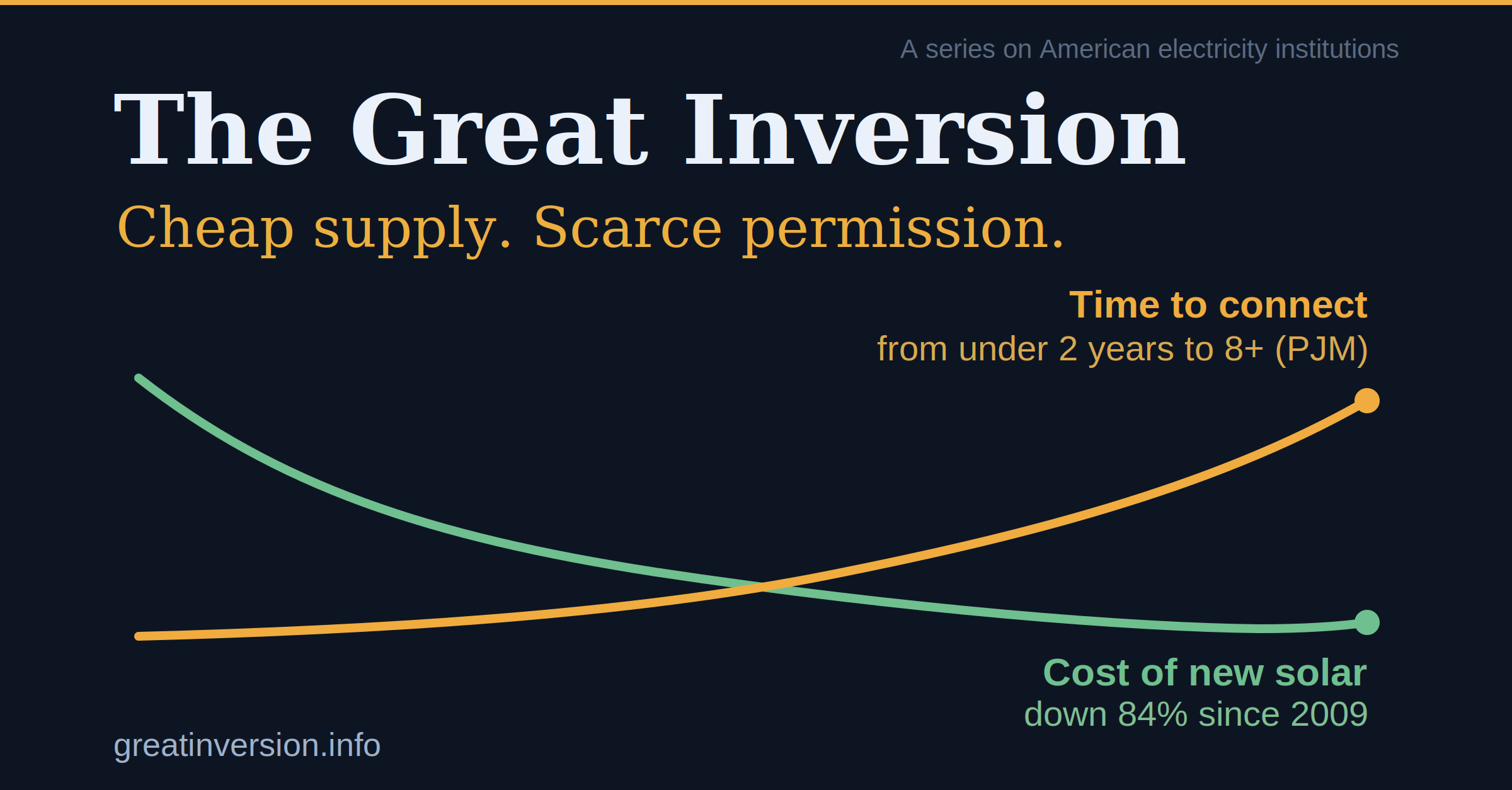
The cost of new solar falling across the same years the time to connect stretched from under two to more than eight.

PNG image, 1200 by 627

Slide deck. The Great Inversion, 17 slides

Presentation deck: the dashboard, the five rules, the five principles, who wins and who fights, the roadmap, the bill, 2035.

Presentation, 17 slides

Press kit

Figures, lines, and sources

Verified figures on the left, quotable lines on the right, and a placement-ready op-ed. For dated news pegs (orders, statutes, filings) use the momentum ledger. ·

Figures

2,061 GWactive interconnection queue at year-end 2025, about one and a half times the operating fleet. 549 GW of it holds a draft or executed interconnection agreement, though more than 40 percent of capacity withdraws even after that stage.LBNL, Queued Up: 2026 Edition
13%of queued capacity has historically reached operation, while three quarters is withdrawn. Median duration now exceeds five years.LBNL, Queued Up: 2026 Edition
8+ yearsPJM's average interconnection application to commercial operation in 2025, from under two years in 2008.RMI, 2026
4 auctionsconsecutive PJM capacity auctions that hit administrative price caps, most recently $325/MW-day. The December 2025 auction fell 6,623 MW short of its reliability requirement.PJM auction reports
$2.2B to $16.4BPJM annual capacity cost across four years of auctions, spread across 67 million people in 13 states and DC.PJM
84% and 93%declines in utility-scale solar levelized cost since 2009 and in battery pack prices since 2010. Solar is $40-98/MWh unsubsidized against $144-276 for a gas peaker.Lazard LCOE+ 2026; BloombergNEF 2025
+33%nominal residential electricity rates since 2019. Electric and gas utilities requested a record $31 billion of rate increases in 2025, double the prior year, and only two of the 83 cases tracked were rejected.LBNL, 2026; PowerLines, 2026
~5 yearslead time for heavy-duty gas turbines, up from about two years in 2019. GE Vernova's gas backlog plus slot reservations grew from 83 GW to 100 GW in a single quarter.IEEFA; GE Vernova 8-K, April 2026
~100 GWof new large load that could be integrated on the existing grid with modest curtailment flexibility, avoiding roughly $100 to $220 billion of generation capital.Nicholas Institute, Duke University, 2025
~2x capacityfrom reconductoring existing corridors with advanced conductors, at roughly half the cost of new build and with limited new permitting. DOE lent AEP Texas up to $3.26 billion to do it across 2,800+ miles.Chojkiewicz et al., PNAS 2024; DOE, July 2026
Quotable

The grid no longer suffers from scarce electricity. It suffers from scarce permission.Executive summary
The monopoly has narrowed. Wires remain a natural monopoly. Generation does not. Storage does not. Demand flexibility does not.Paper II
The question this series answers is why a nation that got very good at building cheap generation got very bad at plugging it in.Paper II
When an auction clears at a ceiling negotiated with a governor, while attracting almost no entry, it has stopped discovering prices and started administering them.Paper II
The planner is honest, the engineering analysis is competent, and the substation still gets proposed.Paper II
Complete the market where competition can work; strengthen regulation where monopoly remains.Paper III
One of the country's largest pools of prospective infrastructure is already in development or awaiting connection.Op-ed
Different institutions. Different pathways. Same principles.Paper IV

Attribution: cite the document named under each line.

Assets: the social graphic (PNG) · the slide deck.

Source discipline. OBSERVED is directly reported data; DERIVED is calculated from it; SCENARIO is model-dependent; INTERPRETATION is an analytical conclusion. The series keeps each separate.

What happens next

Change the payoff and the gate

This is not waiting on Washington. States can begin now.

Commissioners already hold most of the authority.

Utilities know how to earn under these rules; their British counterparts have for a decade.

Consumers are paying for the delay now, on every bill.

The technology exists, capital is waiting for financeable revenue and a predictable connection, and the demand is here.

Change the payoff and the gate.